Anatomy of a Diamond
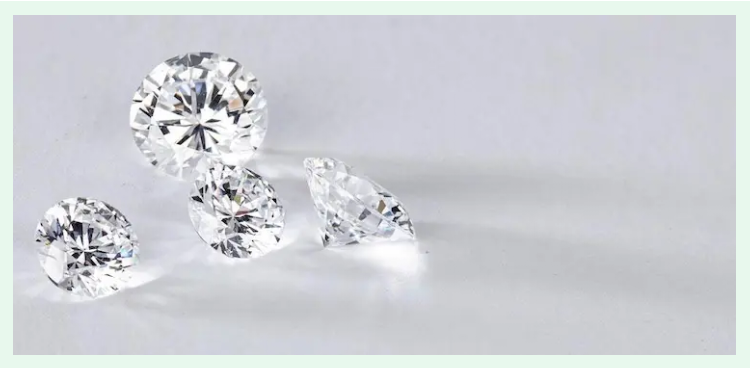
4 Cs provides a very reliable overview when evaluating the quality of diamonds. However, gemologists or experienced diamond buyers will go beyond the 4C criteria and focus on finer details. These details include the structure and Angle of the diamond, the fluorescence level, the degree of inclusion, and the quality of the finish.
Diamond structure
While diamonds come in many shapes and sizes, all diamonds have a total of five structural elements. The Angle at which these five elements are produced determines how much light a diamond reflects, and thus how shiny it is.
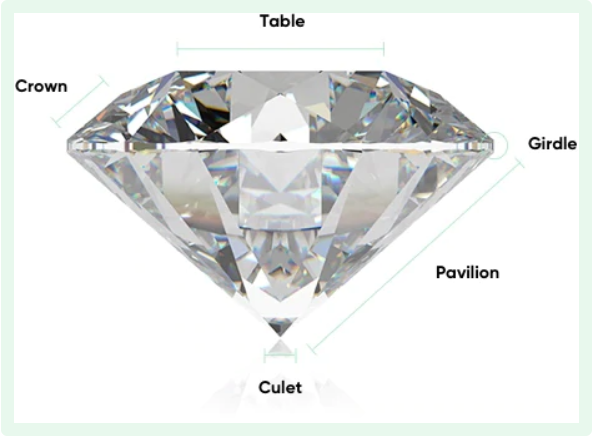
Countertop - Countertop is the flattest surface of a diamond. Whatever the shape of the diamond, it is the largest face.
How it works: When light enters the diamond, the diamond's countertop refracts it downward. In turn, the light bounces back from the pavilion and passes through the table -- thus, most of the diamond's light reaches the observer's eye through the table. The size of the countertop affects the amount of light that can enter the diamond. Therefore, it is an important factor used by gemologists when assigning cut grades to diamonds.
Crown - The crown of a diamond is the structure that sits above the waist.
How it works:
Similar to a diamond countertop, refracted light passes through the crown of the surface and is then reflected back to the observer's eye from the pavilion. The different surfaces distribute light in different directions, resulting in a colorful and amazing fire color.
Loin - The loin is the widest part of a diamond: the outermost edge where the crown meets the bottom. The waistline is usually hidden and flush with the braces when placed in them. The waist of the diamond can be seen in the claw or groove ring.
How it works:
Gemologists consider the waist of a diamond when assigning cut grades. If the waist is too thin or thick, they will only give the diamond a Very Good or Good cut grade, even if the diamond has enough sparkle and structural stability.
Crown - The area of a diamond crown that begins at the waist and ends at the bottom of the tip.
How it works: Most of the weight of a diamond is usually in its pavilion. This means it is often considered the most valuable part of a diamond - but its Angle is more important than its size.
The diamond pavilion is neither too deep nor too shallow, which is crucial. A deep pavilion will darken the diamond because it will not reflect enough light back to the observer's eye through the crown. Viewed from the table, the shallow pavilion produces a "fish-eye" effect, which is caused by the waist reflection in the middle of the countertop, making the diamonds appear dull.
The best pavilion Angle is between 42.5% and 43.5%.
Diamond proportion
When a gemologist grades a diamond, she measures its proportions and then calculates five ratios: depth percentage, mesa percentage, crown Angle and pavilion Angle. These ratios help determine the cut grade of the diamond and are included in its grading report.
Depth percentage
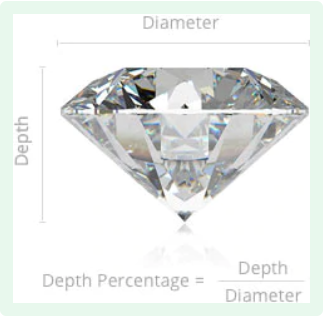
The depth percentage is one of the key factors in determining the cutting grade of a diamond. The depth percentage is expressed as the ratio of the distance from the top to the tip bottom to the diameter of the diamond measured across the waistline.
The depth should be 54 to 66 percent of the diameter of the diamond for optimal sparkle. The depth percentage of diamonds with cut grades "Excellent" and "Ideal" is within this range.
Mesa percentage
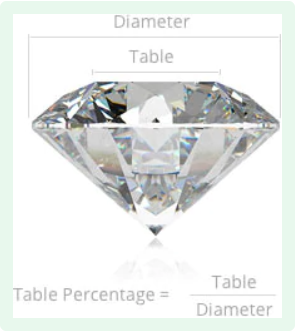
The countertop percentage is the balance between the width of the countertop and the diameter of the diamond to produce the best flash. If the width of the table is too large or too small compared to the diameter of the diamond, the top of the diamond will appear flat or rounded, which will affect the flash either way.
The ideal countertop percentage is between 53% and 70%.
Crown Angle冠角
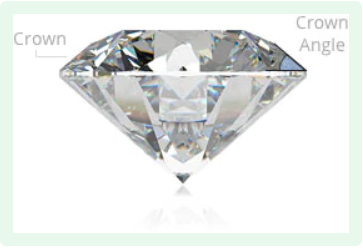
If the crown Angle is too large, the flash will be limited when viewed from above. If the crown Angle is too small, the top of the diamond may appear clear and transparent. Diamonds cut at the best Angle produce more flash.
The crown Angle of most round diamonds is between 30% and 35%. Crown Angle for Ideal cut diamonds must be between 33.7% and 35.8%.
Pavilion Angle亭角
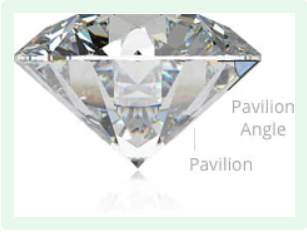
As with the crown Angle, if the pavilion Angle is too large, it will not give off a noticeable flash. If it is too shallow, the diamond may appear glassy. When cut properly, the pavilion will reflect the brightest light through the top of the diamond.
The best pavilion Angle is in the 42.5% to 43.5% range.
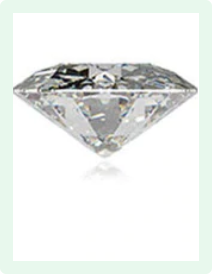
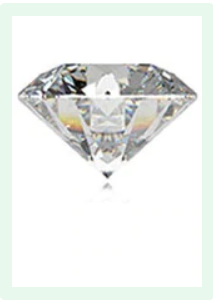
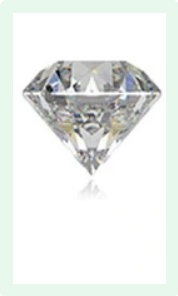
These three diamonds illustrate the difference between a diamond with the right proportion (center) and one that is too shallow (left) or too deep (right).
 |
 |
 |
|
Depth percentage too shallow: 53% and below.
Mesa percentage too low. Crown Angle and pavilion Angle are too shallow.
|
Depth percentage is ideal for maximum flash: 54-66%.
Table percentages are ideal. The Angle between crown and pavilion angles is optimal.
|
Depth percentage too deep: 67% and above. Table percentages are too high. The Angle between crown and pavilion is too large.
|
Note: the above percentages are specific to round diamonds. The ideal proportions for other diamond shapes are slightly different.
Diamond is symmetrical
When grading diamonds, gemologists evaluate the symmetry of the faceted face. Symmetry is an important factor in determining the cut grade of a diamond, and this is reflected in diamond pricing: diamonds with excellent symmetry and polish can be 10 to 15 percent more expensive than those with good symmetry and polish.
Why is symmetry important? When all the facets of a diamond are perfectly aligned, the light that enters it is reflected back, creating a glow. When the facets are not properly aligned, less light is reflected, resulting in shadow spots.
Diamond symmetry is graded from excellent to poor. Excellent symmetry shows that everything is perfectly aligned. The symmetry of the diamond may be affected if the tip and countertop are off-center, the face is deformed, or the waist is not straight. The dislocation of the crown and the waist is also a defect of symmetry.
The symmetry grades of certified diamonds are shown in their grading report. Mondia does not offer diamonds of average or poor symmetry grades, so you can be sure that your diamonds are of exceptional brilliance.
Diamond inclusions and defects
The clarity grade of a diamond depends on the size and visibility of its inclusions and imperfections. Inclusions are natural defects in the diamond, and defects are naturally occurring defects on the surface of the diamond. Unlike polishing defects, they occur naturally and are not caused by human error during the polishing process.
Cavity 空腔
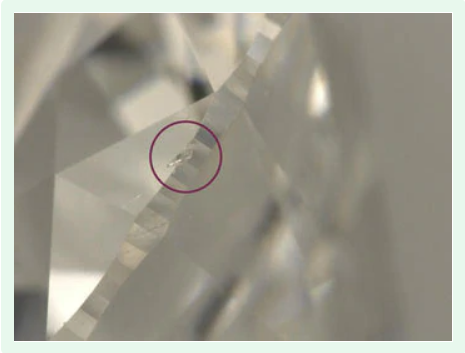
Essentially a hole in the surface of a diamond, voids can be found in a variety of sizes and locations throughout the diamond. Depending on its location, the cavity may affect the overall durability of the stone. If the cavity is on the table, it will stand out when set in jewelry, compromising the value and quality of the diamond.
Chip 缺口
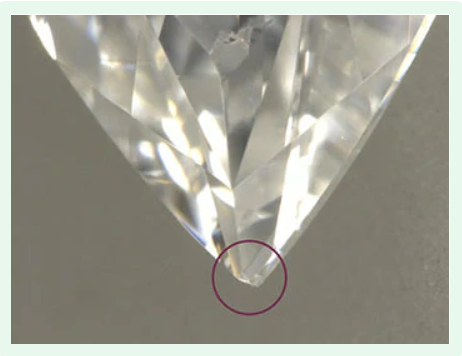
Sometimes chips produced during diamond cutting are shallow indentations on the surface of the diamond. The sharpness map report will indicate their location. If on the edge of the diamond, it may be set to invisible. This can cause feather-like fragments around the edge of the diamond.
clouds雾团
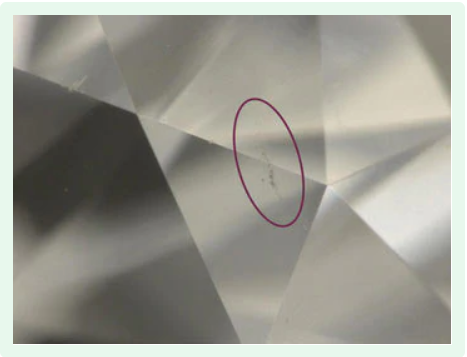
The fog is a group of tiny inclusions that are indistinguishable from one another even under a magnifying glass. They appear as a translucent mist inside the diamond, invisible to the naked eye. Therefore, they do not affect clarity levels to a large extent.
Crystals 晶体
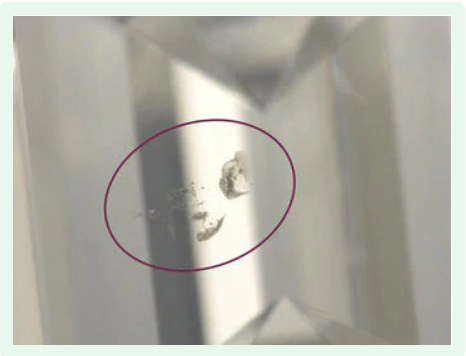
Crystals of other minerals can be contained within the larger structure of the diamond. Although crystals are usually the smaller presence of diamonds, they can also be red garnet, green emeralds, etc. Dark crystals of carbon are also common. Crystals come in a variety of sizes, colors and positions. If they are brightly colored and visible, they can affect the clarity and value of the diamond.
Feathering羽状物
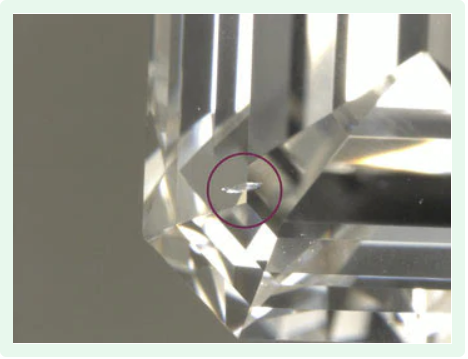
Eclosion is a crack in a diamond that may have formed billions of years ago when the diamond was first formed. The position and size of the feather will affect the clarity of the diamond. If located on the edge, the tip can easily hide feathers. Only near the waist or as a mesa mouth, they will have a greater impact.
Knot 结节
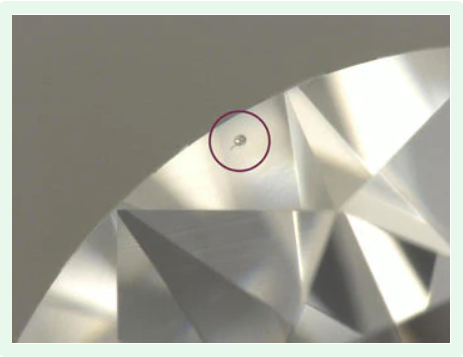
A nodule is a diamond crystal inclusion that breaks into the surface of the finished diamond. Under a strong magnifying glass, it should be clear what the difference is between the inclusions and the larger stones. During the polishing process, drag lines are created as the polishing wheel passes through the inclusions. The nodule may be higher than the rest of its face: depending on its size, you may feel it when you place your finger on the diamond.
Indented Natural自然收缩
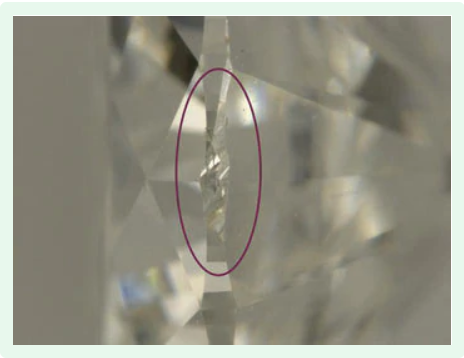
Indented Natural shrinkage technically, the shrinkage part - because it occurs on the outside of the diamond structure the unpolished part of the diamond. Originally part of the "skin" of a rough diamond, it is usually found at or around the waist. If they are in the crown or pavilion, they will be considered to shrink naturally. Although included in the clarity diagram, they do not affect the overall quality and durability of the diamond. Unlike other imperfections or inclusions, the shrinkage has always existed and is mostly seen as a reminder of the diamond's organic history.
Needle针状物
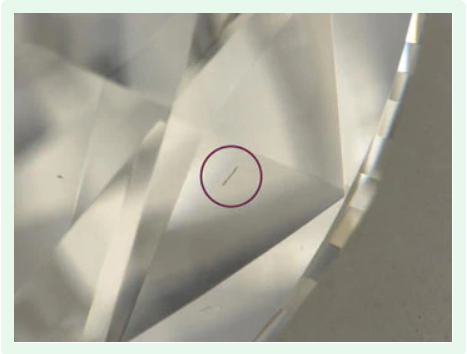
Spicules are similar to feather inclusions -- but only with a thin, very narrow line. They usually do not affect the light returned from diamonds and can be white or transparent. Some spicules may be longer and therefore more pronounced.
Pinpoint Inclusion细小的包含物
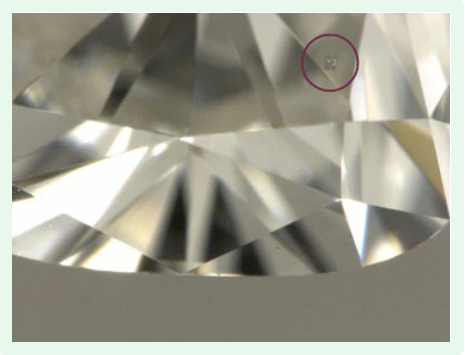
Usually, fine inclusions are the difference between VVS1 clarity and IF clarity. A speck in a diamond that can usually only be detected at high magnification. They do not affect the overall durability of the diamond.
Twinning Wisp孪晶
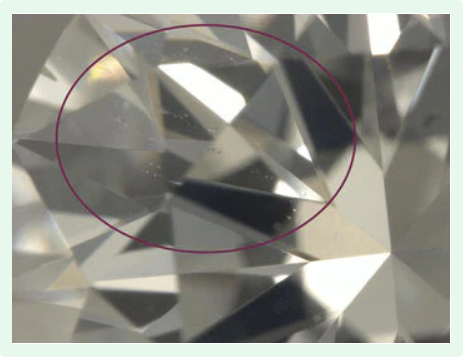
Twins (sometimes called mutual growth) are the result of growth defects within the diamond crystal structure. Different inclusions twisted together, most commonly found in fancy cuts, as in pear-shaped diamonds. These inclusion groups are generally easier to detect than others due to their white striped appearance. As a result, they are usually found in diamonds with lower clarity grades, such as SI1.
The internal and external characteristics of the diamond you plan to purchase are shown on an easy-to-read chart on the diamond grading report. Each inclusion or flaw is indicated by a small symbol at the location of the inclusion.
Diamond polishing
After the diamond is cut, it is polished to give a smooth finish. Each facet is polished on a wheel to improve the sparkle of the diamond. In the process, the polishing wheel creates tiny scratches on the surface of the diamond. Almost every diamond has polished marks on its surface. If the scratches are large enough, they can misdirect the light passing through the diamond, reducing its brightness.
After the polishing process is complete, gemologists evaluate these defects and specify the polishing grade, which can be found in the grading report of the diamond. Diamonds with no visible polishing defects are awarded an "excellent" polishing rating. Very good and good finish grades indicate that defects are hard to see, even under 10x magnifying glasses. If you want to ensure exceptional brilliance, select one of the polish grades.
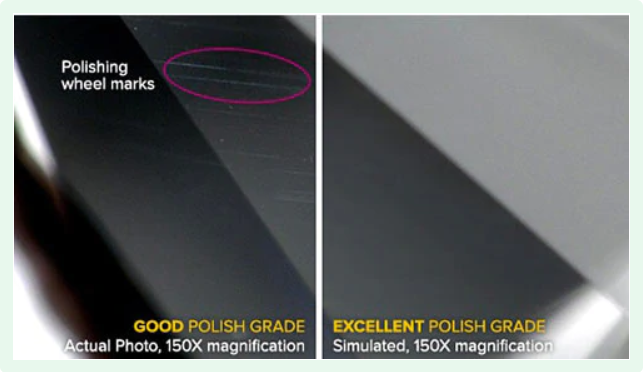
Mondia does not offer diamonds with "average" or "poor" polishing grades, making it easier for you to choose quality diamonds.
It is important to note that diamond polishes are graded separately from clarity and are not considered inclusions as they do not penetrate the diamond surface.
Buying tip: Polishing has a relatively small impact on the overall appearance of a diamond, so we do not recommend you make a purchase decision based solely on the polish grade of the diamond. But if you want a truly spectacular diamond, look for a 3EX diamond: superior finish, superior symmetry and superior cut grade.
Diamond fluorescence
About 30% of diamonds glow naturally under ultraviolet light. This is called fluorescence. It is caused by abnormalities in the diamond crystal structure, which range from weak to very strong. Fluorescence differs from diamond color grades and is usually not seen in natural light.
Diamond fluorescence intensity diagram
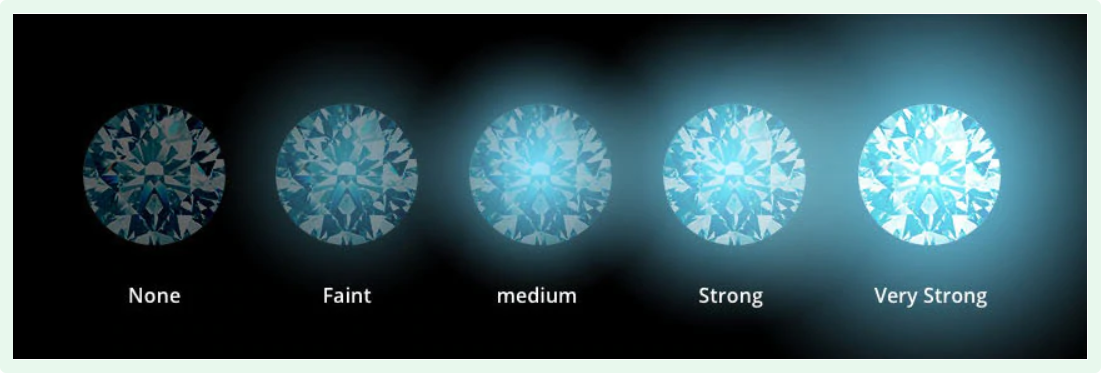
Different levels of fluorescence under ultraviolet light. The fluorescent level of your diamond is listed in its diamond grading report.
Diamonds without fluorescence are priced at a premium because quality is sometimes considered defective. However, since fluorescence is usually not visible under natural light, the effect on diamond appearance is negligible; Therefore, we do not recommend selecting your diamond primarily on the basis of its fluorescence level.
Diamonds with weak to moderate fluorescence are generally a more cost-effective choice; By not paying a premium for non-fluorescent diamonds, you can invest in higher cut or clarity grades (both of which have a greater impact on the diamond's appearance). In addition, if a highly fluorescent diamond also has a pale yellow (K and L) or nearly colorless (I and J) color grade, it may actually look whiter -- the fluorescent blue tone neatly balances the yellow tone. This can cause the diamond to appear to have a higher color grade than it really is.
While most fluorescent diamonds take on a blue hue under ULTRAVIOLET light, other colors are possible. Rare yellow, orange, green and red fluorescence has been recorded. If these tones complement the primary color, they can increase the appeal of colored diamonds. For example, the intensity of fancy yellow diamonds with yellow fluorescence will attract many diamond customers, potentially increasing the value of the diamond.